
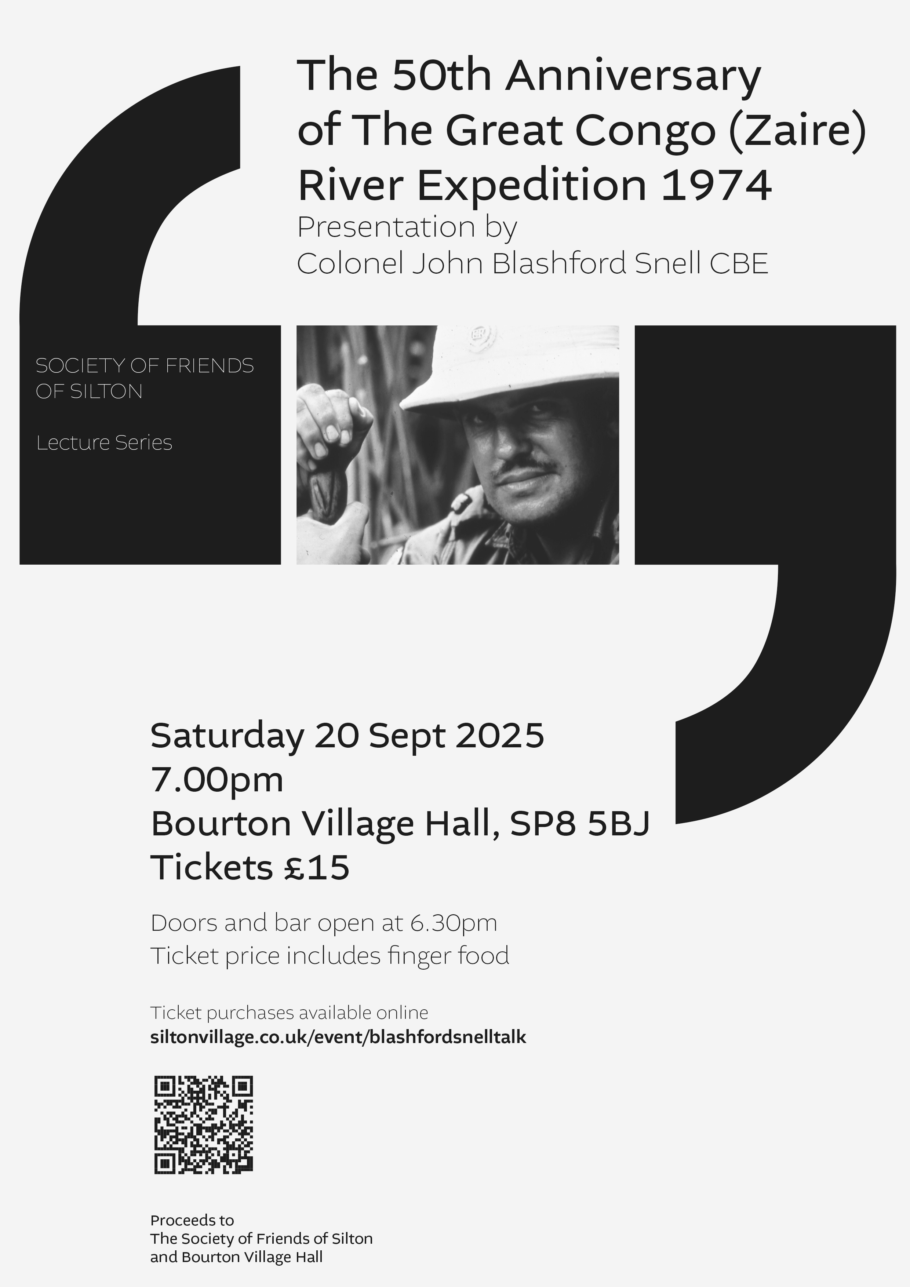
Presentation by Colonel John Blashford Snell CBE
Purchase tickets here
The Great Zaire-Congo Expedition, in the Steps of Stanley
by Colonel John Blashford-Snell, CBE
Leader of the expedition (1974-75)
Seeking to discover the source of the Nile, Henry Morton Stanley set out from Zanzibar in November 1874 with three Britons and 356 Africans. After an incredible journey by land and river spanning 999 days following his famous meeting with Dr David Livingstone in 1871, Stanley had crossed Africa, coast to coast, finally emerging with only 115 survivors. The vast central African territory became the Belgian Congo and having gained independence from Belgium in 1960, it was renamed the Republic of the Congo after the mighty river that runs through it. In 1971 President Mobutu renamed it the Republic of Zaire and in 1997 it became the Democratic Republic of the Congo following Mobutu’s downfall. It was in 1970 that the Scientific Exploration Society started work on a proposal to navigate the Zaire River, now renamed the Congo. The plan was to use this ferocious 2,700 mile waterway as a route through the Congo Basin enabling scientific and medical teams to explore the still little-known interior, commemorating the centenary of Stanley’s epic journey.
Backed by the Ministry of Defence and many companies, including the Royal Trust Co of Canada (CI) and the Daily Telegraph, the team flew into Lubumbashi in President Mobutu’s DC-10 in October 1974. There were 165 of us including fifty medics, scientists and administrators and although the majority came from Britain, there were also members from the United States, Canada, New Zealand, Australia, Denmark, France, Holland, Nepal, Fiji as well as twenty soldiers and scientists from Zaire itself. Royal Engineers led by Major Ernie Durey of Weymouth and the late Captain Jim Masters of Somerton played a leading part in the expedition as did a Royal Marine team led by the late Captain Mike Gambier of Taunton. Lord Coleridge of Ottery St Mary commanded one of the support teams.
A major task was the study of Onchocerciasis or River Blindness affecting over 20 million Africans. Botanists, entomologists, geologists and zoologists also joined the expedition, and the late Jeremy Mallinson of Jersey Zoo led a team to study primates.
Various craft were used to navigate the enormous river, including Avon whitewater rafts. Royal Engineers constructed forty-foot inflatables and thanks to the help of the late Duke of Edinburgh we had two powerful Hamilton Jet Boats.
Encounters with wildlife livened the voyage. An Avon was destroyed by an angry hippo, but the crew included an Army Padre, an Olympic canoeist, whose prayers ensured the men’s survival! On another occasion, a swimming cobra climbed into a boat, forcing an instant evacuation. In dense forest Jeremy Mallinson encountered a massive mountain gorilla and by chance we discovered a rare Bonobo chimpanzee in a local lady’s home!
My PA, the late Lady Pamela Coleridge of Ottery St Mary, homed a pet bushbaby in her shirt, who would pop out to terrify the locals! Pam had been the personal nurse to President Mobutu which proved of real value to the expedition. We were also fortunate to find the endangered okapi, a type of giraffe, in the dense forests.
Bands of dissidents were kept at bay by weapons provided by the Zaire Army which thankfully we did not need to use. Accidents and illnesses suffered by our team were treated successfully by our eleven doctors and only two casualties had to be evacuated by air.
The tireless 19 strong international ophthalmic group covered some 6,000 miles of jungle, savannah and river to examine hundreds afflicted by River Blindness to produce a vital report for WHO.
In the final stretch of the river massive rapids with 20-foot waves, faced us. A giant inflatable, punctured on a rock was pulled to safety by a jet boat and Corporal Neil Rickard, Royal Marines was awarded the Queen’s Gallantry Medal for rescuing three men from a huge whirlpool, into which their boat had capsized.
The success of the venture was largely due to well organised logistics, especially the support of the Army Air Corps Beaver that parachuted in supplies and flew ahead to recce the route through the cataracts.
After 109 days we reached the Atlantic and held a Thanksgiving Service on our flag boat and received a message of congratulation from HM The Queen.
The results of the scientific and medical work and the navigational achievements won wide acclaim. The example and public lectures of two young men on the team inspired the Prince of Wales to launch Operations Drake and Raleigh for leadership development which has created over 50,000 young leaders, and Raleigh International continues to run expeditions today.
Without doubt the expedition had been a worthwhile project with a good mixture of science and adventure, showing that there were still plenty of people about with the same healthy contempt for difficulties and dangers such as Stanley and Livingstone had endured. This is what the Scientific Exploration Society is seeking to encourage today.
Purchase tickets here
